Why Stampede Is Harder on Your Body Than You Expect
Most people would not describe attending the Stampede as physically demanding, but the cumulative load on your body tells a different story. On a typical Stampede day, visitors easily walk six to ten kilometres, much of it on hard concrete and asphalt surfaces with minimal cushioning. That sustained low-level impact, repeated over several days, adds up.
The problem is compounded by footwear choices. Cowboy boots are practically a Stampede requirement for a large portion of Calgary attendees, and while they look the part, they offer very little in the way of arch support, lateral stability, or shock absorption. Wearing boots for eight or ten hours on hard ground places significant stress on the feet, knees, hips, and lower back.
Add in hours of standing on sloped bleachers for the rodeo, leaning forward over railings to watch chuckwagon races, and the sustained awkward postures that come with navigating crowded spaces, and you have a recipe for back and neck discomfort that builds steadily throughout the week.
What Your Lower Back Is Dealing With
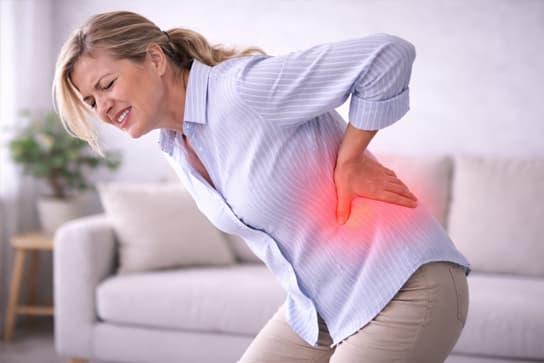
The lumbar spine is particularly vulnerable during prolonged standing and walking on hard surfaces. When the normal cushioning provided by supportive footwear is absent, each step transmits more compressive force upward through the ankles, knees, and hips into the lower back. Over the course of a long Stampede day, the muscles supporting the lumbar spine fatigue, and surrounding joints begin to absorb load they are not designed to manage over extended periods.
Prolonged standing also encourages a subtle forward shift in pelvic posture. Many people compensate by slightly hyperextending the lower back, which can increase compressive loading on the lumbar facet joints and contribute to that familiar aching stiffness that sets in toward the end of the day.
If you already carry some lower back tightness or have a history of disc-related discomfort, the Stampede environment can be enough to tip a manageable background pattern into something more symptomatic. Our overview of back pain and contributing factors covers these mechanical patterns in more detail.
Neck and Upper Back Tension
Stampede is also loud, crowded, and visually stimulating, which means a great deal of time spent craning the neck, looking upward at stage performances, twisting to follow the action in the arena, or looking down at a phone to check schedules and share photos. These repeated postures load the cervical spine and upper back in ways that accumulate over hours.
Grandstand seating often involves sustained periods in fixed, forward-leaning positions that place steady tension through the upper trapezius, levator scapulae, and the suboccipital muscles at the base of the skull. By the end of a full day, this tension is a common source of neck stiffness and headaches that linger into the following morning.
The Footwear Problem
This is worth addressing directly because it affects so many Calgary Stampede-goers. Cowboy boots typically feature a heel elevation of three to five centimetres, a pointed or narrow toe box that limits toe splay, and a relatively rigid sole with minimal arch contouring. For a few hours of wear, this is manageable. For a full day on concrete, it significantly alters gait mechanics.
The elevated heel shifts body weight forward onto the ball of the foot, increases lumbar extension load, and changes how forces travel through the knee. The narrow toe box can contribute to foot fatigue and lateral forefoot pressure. None of this is catastrophic in isolation, but layered over eight to ten hours of walking on hard ground across multiple Stampede days, the effect on the lower back and hips can be meaningful.
If you are attending multiple days, alternating between boots and a well-supported sneaker on lower-key days can make a noticeable difference.
How to Manage During the Ten Days
A few practical adjustments can help reduce how much the Stampede takes out of you physically.
Take seated breaks deliberately. Rather than waiting until you are exhausted, build in regular rest periods. Even ten to fifteen minutes off your feet every couple of hours allows the lumbar musculature to decompress and recover before fatigue sets in fully.
Stretch before and after long days. A simple hip flexor stretch, a gentle standing lumbar extension, and a brief upper trapezius stretch take under five minutes and can meaningfully reduce the stiffness that builds during prolonged walking. Your lower back will respond well to even a short mobility routine before bed.
Watch your sleeping position. After a long Stampede day, sleeping in a position that allows your lower back to decompress matters. Side lying with a pillow between the knees, or back lying with a pillow under the knees, reduces overnight lumbar loading and helps you wake up with less stiffness going into the next day.
Stay hydrated. Heat, sun exposure, and alcohol consumption are all part of the Stampede experience for many Calgarians, and all three contribute to dehydration. Dehydration reduces the water content of spinal discs and surrounding soft tissues, making them less resilient to the loading demands of a long day on your feet.
When to See a Calgary Chiropractor
Most Stampede-related back discomfort resolves within a few days of returning to normal routine. If soreness or stiffness persists beyond a week, is worsening rather than improving, or is accompanied by symptoms radiating into the legs or arms, a clinical assessment is worth arranging.
For Calgarians who notice that the Stampede reliably aggravates a pre-existing back issue, it may also be worth addressing that underlying pattern before next July rather than managing the fallout after. Chiropractic assessment can help identify whether mechanical contributors are present that would benefit from attention outside of the event itself.
Our $95 new patient offer makes arranging that first visit straightforward, and our team is always happy to answer questions about whether chiropractic care is appropriate for your specific situation. You can also visit our back pain page or FAQ page for more information on what to expect from care.