Whiplash is one of the most common injuries following a motor vehicle collision, yet its symptoms are frequently misunderstood. Many people feel relatively unaffected immediately after an accident, only to notice increasing neck stiffness, headaches, and discomfort over the following 24 to 72 hours.
The delay in symptom onset can lead people to underestimate the significance of the injury. In many cases, the physical effects of a collision are still developing during that initial window - and addressing them early often leads to smoother, faster recovery.
Whiplash presentations vary considerably between individuals. Some people experience mild, short-lived stiffness. Others develop persistent neck pain, recurring headaches, jaw tension, or symptoms that extend into the shoulders and upper back.
Whiplash describes the pattern of cervical spine injury that occurs when the head and torso accelerate at different rates during a sudden impact. The neck moves rapidly forward and backward - or side to side - before the surrounding musculature can engage to protect it.
This rapid loading places sudden stress on the cervical joints, intervertebral discs, surrounding ligaments, and supporting musculature. The result is often a combination of joint irritation, muscular guarding, and soft tissue strain.
The severity of the forces involved does not always predict the severity of symptoms. Some individuals experience significant discomfort from relatively minor impacts, while others report fewer symptoms after more forceful collisions. Individual factors including baseline neck mobility, position at impact, headrest placement, and whether bracing occurred all influence how the injury presents.
Adrenaline released during the event can temporarily suppress pain perception, which is why many people report feeling fine immediately after an accident. As this response subsides over the following days, underlying tissue irritation often becomes more noticeable.
When To Seek Evaluation
You may wish to seek assessment if:
Neck stiffness persists beyond a few days
Headaches develop or worsen after an accident
Shoulder or upper back tension is present
Movement in any direction becomes restricted
Jaw tightness or discomfort is noticed
Dizziness or balance changes occur
Numbness or tingling develops in the arms or hands
Symptoms are progressing rather than gradually improving
Early evaluation after a collision helps clarify what structures are involved and guides care before compensatory patterns become established.
These factors are assessed individually to guide care that is appropriate for each patient's specific presentation.
Our Approach to Whiplash Recovery
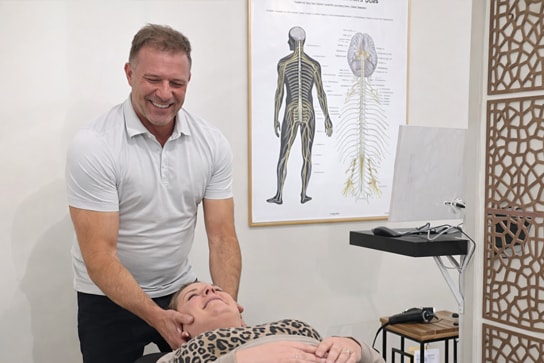
Chiropractic care for whiplash focuses on restoring joint mobility, addressing muscular guarding, and improving movement quality in the cervical spine and surrounding regions.
Assessment considers the full picture - not just the primary area of discomfort, but also how the upper back, shoulders, and jaw may be responding. Whiplash commonly involves a wider pattern of mechanical disruption than is initially apparent.
Treatment in the early stages is deliberately conservative - gentle joint mobilization and soft tissue work adapted to the current level of tissue sensitivity. As recovery progresses, care evolves to normalize movement mechanics and reduce tension patterns that, if left unaddressed, can sustain discomfort well beyond the initial healing period.
Assessment considers:
Cervical joint mobility and movement quality
Muscular guarding and tension patterns
Headache presentation and origin
Upper back and shoulder involvement
Postural and movement adaptations
Symptom timeline and progression
Treatment remains gentle, individualized, and adapted to your comfort at each stage of recovery.
Care prioritizes restoring comfortable movement, reducing compensatory tension patterns, and supporting a durable recovery.
Don't wait to start feeling better.
Easily book your appointment online and find relief in our comfortable, welcoming clinic
New Patient Offer
A focused consultation and mechanical assessment helps clarify how a collision has influenced cervical joint mobility, muscular tension, and movement patterns - and what care is most appropriate for your current presentation.
Many patients appreciate a measured, collaborative approach that prioritizes gradual improvement, clear communication, and techniques tailored specifically to their presentation.
Calgary roads are busy. Deerfoot Trail, Crowchild, and the ring road see their share of rear-end collisions, intersection impacts, and minor fender-benders year-round. And while many Calgarians walk away from these events feeling shaken but otherwise fine, neck pain and stiffness often surface hours or even days later.
Motor vehicle accidents often expose the body to sudden acceleration and deceleration forces. Even relatively minor collisions may influence joint mechanics, soft tissues, and movement patterns.
Whiplash-associated symptoms are commonly reported following motor vehicle collisions. Sudden acceleration and deceleration forces may influence cervical spine mechanics, soft tissues, and movement patterns.
Updated January 17, 2026
Recovering From Whiplash?
Whiplash symptoms often develop in the days following a motor vehicle collision or impact. Neck stiffness, headaches, and reduced mobility are common - and early chiropractic assessment frequently supports a smoother, faster recovery.
A focused consultation and mechanical assessment helps clarify how a collision has influenced cervical joint mobility, muscular tension, and movement patterns.
A focused consultation and mechanical assessment helps clarify how a collision has influenced cervical joint mobility, muscular tension, and movement patterns.